Architecting Resilience: A Deep Dive into the AI English Grammar Diagnostic Platform
In the rapidly evolving landscape of EdTech, the intersection of Large Language Models (LLMs) and pedagogical rigor presents a significant engineering challenge. How do you build a system that leverages the generative power of AI without sacrificing the linguistic accuracy required for standardized testing? This article dissects the architectural blueprint of English Practice, an advanced AI English grammar diagnostic platform designed for high-stakes language assessment.
- Hybrid Question Pipeline: Combines real-time OpenRouter LLM generation with a persistent, seeded SQLite question bank.
- Fault-Tolerant Design: Automated fallback to local lexical databases ensures zero-downtime testing during API degradation.
- CEFR-Aligned Diagnostics: Granular performance mapping across A1 to C2 proficiency tiers.
- Modern Stack: Built on Django 5, Python 3.12, and Docker Compose for scalable, containerized deployment.
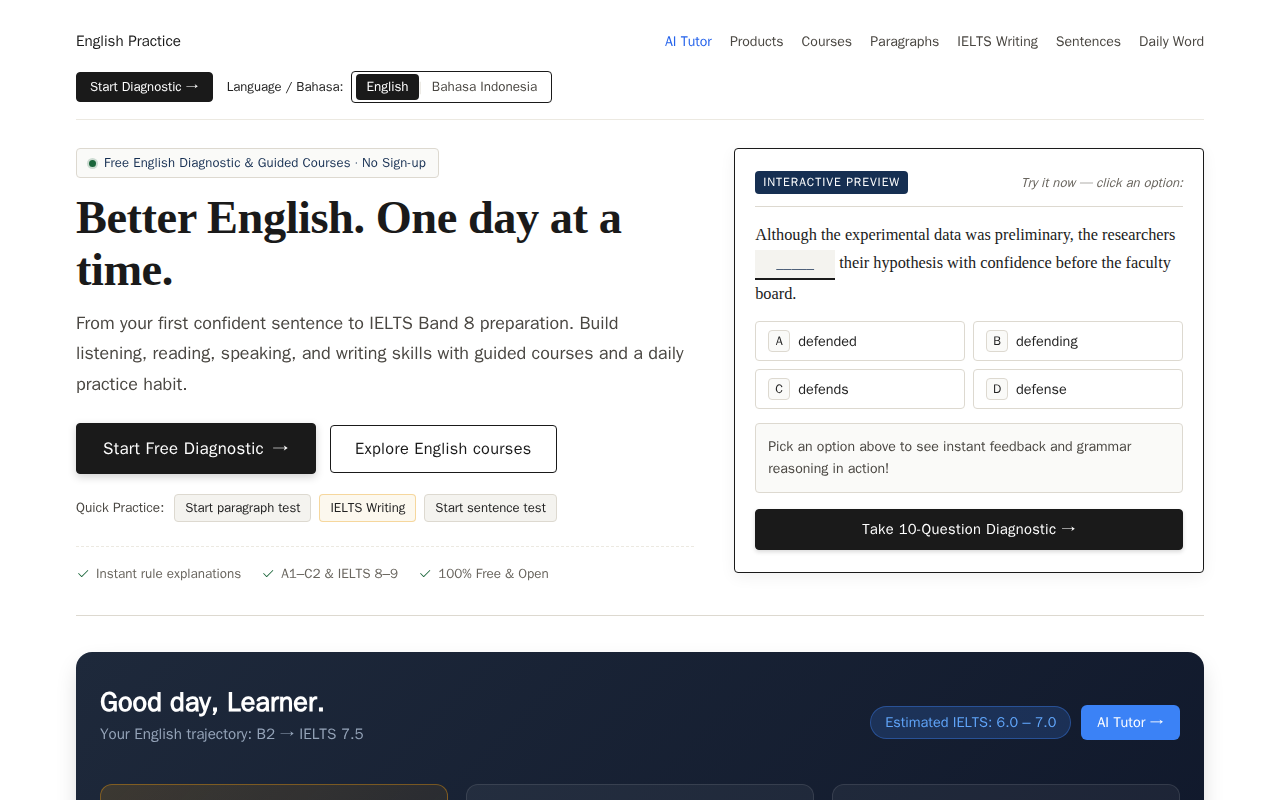
The Engineering Challenge: Why English Practice Diagnostic Was Architected
Traditional language learning platforms suffer from a binary flaw: they are either too static or too unpredictable. Static question banks lead to rote memorization, where students recognize patterns rather than understanding grammatical principles. Conversely, ungrounded AI generators often produce “hallucinated” distractors—incorrect options that are linguistically invalid or ambiguous, undermining the integrity of the assessment.
The English Practice architecture was engineered to solve this by implementing a Hybrid Question Pipeline. By merging structured lexical knowledge (based on the Oxford 5000) with dynamic LLM generation, the platform ensures that every question is both novel and linguistically sound.
Core Architecture & Technical Stack Deep-Dive
The Application Layer: Django 5 & Python 3.12
At its core, the platform utilizes Django 5 to manage complex state transitions between test sessions. The backend handles the orchestration of diagnostic logic, user progress tracking, and the heavy lifting of CEFR-level calibration. By leveraging Python 3.12, the system benefits from enhanced performance and typing capabilities, ensuring the diagnostic engine is both fast and maintainable.
The Intelligence Layer: OpenRouter & Prompt Safety
Rather than being locked into a single model, the platform interfaces with OpenRouter, allowing it to toggle between high-reasoning models like GPT-4o-mini and efficient models like Gemma. To prevent the common pitfalls of generative AI, the architecture includes:
- JSON Schema Validation: All AI-generated questions must conform to a strict schema before being presented to the user.
- Content Fingerprinting: Ensures variety and prevents the repetition of identical question structures.
- Prompt Safety Checks: Guardrails that prevent the generation of off-topic or non-pedagogical content.
The Persistence Layer: SQLite & Data Integrity
To ensure that active test sessions survive container restarts or deployment cycles, the system utilizes a mounted SQLite database. This provides a lightweight yet robust persistence layer for TestSession states and ParagraphBankQuestion archives, making the platform highly suitable for containerized environments managed via Docker Compose.
Key Features Breakdown & Practical Benefits
1. Adaptive Dual-Mode Testing
The platform supports two distinct assessment methodologies:
- Sentence Cloze Testing: Targets specific parts of speech, vocabulary nuances, and word choices.
- Paragraph Multi-Blank Testing: A more advanced mode evaluating contextual reading comprehension and cohesive discourse markers.
2. CEFR-Aligned Diagnostic Analytics
Post-test, the system doesn’t just provide a score; it provides a diagnostic breakdown. By mapping errors to specific grammatical rules and CEFR tiers (A1–C2), learners receive actionable study suggestions rather than vague feedback.
Real-World Deployment & Production Topology
The production environment is architected for high availability and efficient static asset delivery. The topology follows a modern web pattern:
[Student Browser] → [Nginx Proxy] → [Gunicorn/Django] → [SQLite/OpenRouter]Nginx handles incoming HTTP traffic and serves static assets (CSS/JS) via WhiteNoise, while Gunicorn manages the WSGI workers for the Django application. This separation ensures that the application logic remains decoupled from asset delivery, optimizing response times.
Data Flow & How It Works: Step-by-Step Workflow
- Initialization: The user selects a target CEFR level and test mode.
- Question Retrieval: The system attempts to fetch a question from the local
ParagraphBank. If the bank is exhausted or the API is unavailable, the OpenRouter engine is triggered. - AI Synthesis: The LLM generates a question based on the Oxford 5000 lexical constraints, ensuring appropriate difficulty.
- Validation: The backend validates the JSON output against the pedagogical schema.
- Assessment: The user submits answers; the engine calculates accuracy and maps errors to specific grammatical topics.
Architectural Comparison: English Practice vs. Traditional Approaches
| Feature | Traditional Static Platforms | English Practice Diagnostic |
|---|---|---|
| Content Variety | Limited (Fixed Question Bank) | Infinite (AI + Seeded Bank) |
| Reliability | High (But repetitive) | High (Hybrid Fallback Mechanism) |
| Difficulty Scaling | Manual/Coarse | Dynamic (CEFR-Calibrated) |
| Feedback Depth | Binary (Correct/Incorrect) | Granular (Rule-based Diagnostics) |
Frequently Asked Questions (FAQ)
What happens if the AI API goes down?
The platform features an automatic fallback mechanism. If the OpenRouter API is unreachable, the system seamlessly switches to the local, persistent question bank to ensure uninterrupted testing.
How is the CEFR level determined?
The diagnostic engine analyzes error patterns and the complexity of correct answers to estimate the user’s proficiency within the A1 to C2 framework.
Is the platform suitable for classroom use?
Yes. Educators can use the platform to generate customized grammar assessment sessions and provide students with detailed, automated diagnostic reports.
What technology is used for data persistence?
The platform uses SQLite with mounted volumes in a Dockerized environment, ensuring that user sessions and question archives are preserved across system restarts.
Conclusion & Next Steps
The English Practice platform represents a significant step forward in AI-augmented language learning. By prioritizing architectural resilience and pedagogical accuracy through a hybrid LLM-lexical approach, it provides a robust solution for both individual learners and professional educators.
Ready to experience the future of language assessment?
Explore the live platform here: https://english.nevatal.id
Leave a Reply