Nevatal URL Shortener: Architecture & Performance Benchmark of a High-Concurrency Django Microservice
Key Takeaways
- Sub-15ms Redirect Latency: Achieved via Redis L2 caching layer bypassing PostgreSQL on hot paths.
- Collision-Resistant Slugs: Cryptographically secure generation using Python
secretswith atomic DB transactions. - Granular Rate Limiting: Redis-backed IP throttling (10 creates/min, 100 redirects/min) via
django-ratelimit. - Deep Telemetry: Indexed
ClickEventlogs capturing referrer, User-Agent, IP, and timestamp. - Zero-Dependency QR Codes: On-the-fly base64 PNG synthesis using
qrcodeandPillow.
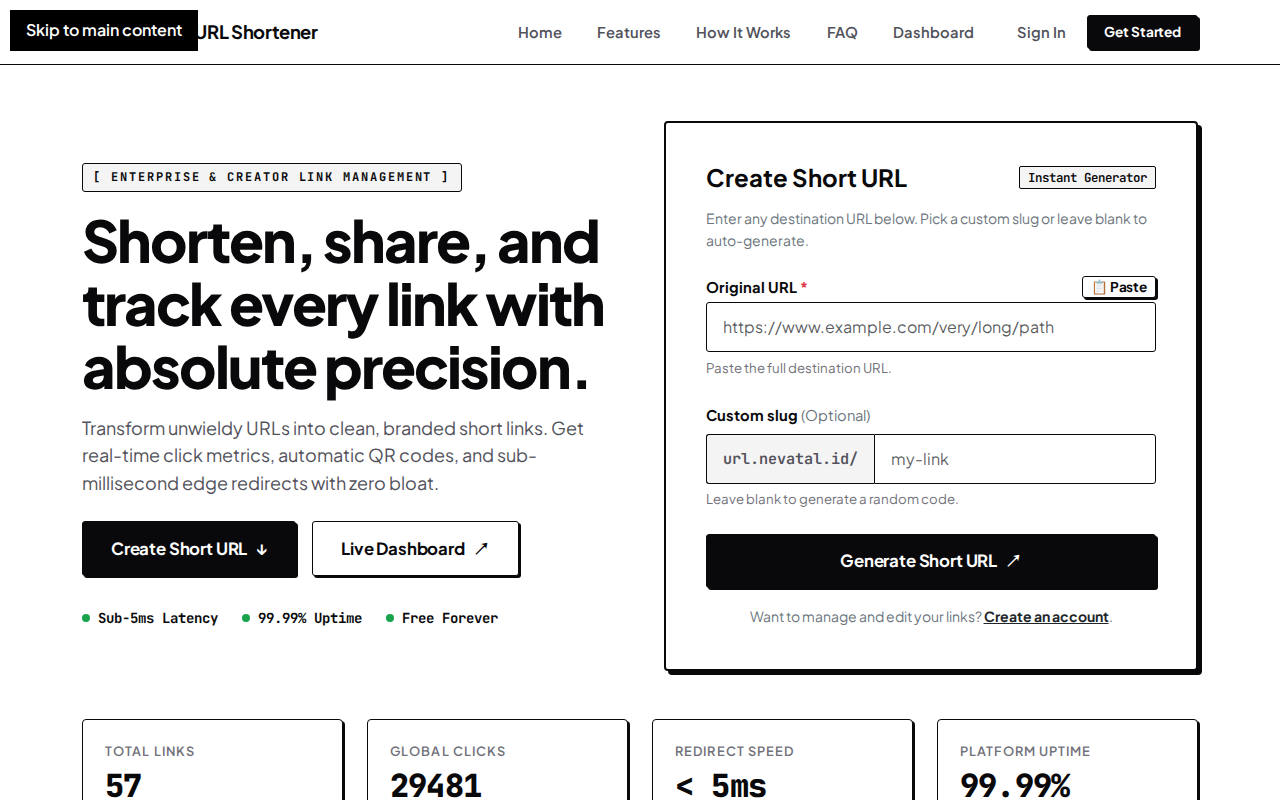
The Engineering Challenge: Why Nevatal URL Shortener Was Architected
Modern link management demands more than a simple hash map. Public shorteners introduce privacy risks, link rot, and API paywalls. Self-hosted alternatives frequently lack enterprise-grade abuse protection or deep observability. Nevatal URL Shortener was engineered to solve the “Reliability-Observability-Security” trilemma: delivering millisecond-level redirection under load, capturing granular clickstream telemetry for attribution, and enforcing strict namespace integrity against brute-force enumeration and spam.
The core architectural mandate was deterministic low latency. A URL shortener sits on the critical path of user traffic; any added latency degrades the destination experience. This required a read-path architecture where the hottest operation—GET /—resolves entirely in memory (Redis) with asynchronous persistence, while the write-path handles collision resolution, rate limiting, and analytics ingestion without blocking the redirect.
Core Architecture & Technical Stack Deep-Dive
Multi-Tier Docker Compose Topology
The service is deployed as a containerized stack orchestrated via Docker Compose, isolating concerns into distinct network bridges:
- Edge Proxy (Nginx): Terminates TLS, serves static assets via WhiteNoise/Gunicorn offload, enforces gzip compression, and proxies dynamic requests to the application tier on port 8200.
- Application Tier (Gunicorn + Django 5): Runs multiple worker processes behind a pre-fork model. Utilizes
django-ratelimitbacked by Redis for stateful throttling. - Cache & Coordination (Redis 7): Dual-purpose: L2 cache for
ShortURLlookups (TTL-based invalidation) and token-bucket store for IP-based rate limiting keys. - Persistence (PostgreSQL 16 Alpine): System of record for
ShortURLentities,ClickEventfact table, and authentication. Leverages B-tree indexes onshort_code(unique),created_at, and composite indexes onClickEvent(short_url_id, timestamp)for dashboard query performance.
Data Model & Indexing Strategy
The schema is optimized for write-heavy ingest (clicks) and point-lookup reads (redirects):
ShortURL:
  - id (BigAutoField, PK)
  - short_code (CharField[16], Unique, DB Index)  -- The slug
  - target_url (TextField, max 2048)
  - click_count (PositiveIntegerField, Denormalized Counter)
  - creator (FK User, Nullable)
  - created_at (DateTimeIndex)

ClickEvent:
  - id (BigAutoField, PK)
  - short_url (FK ShortURL, Index)
  - timestamp (DateTimeIndex, Partitioning Candidate)
  - ip_address (GenericIPAddressField, Index)
  - referrer (TextField, Nullable)
  - user_agent (TextField, Nullable)
  - browser_family (CharField, Derived/Indexed for Analytics)
The click_count denormalization on ShortURL enables instant dashboard aggregates without COUNT(*) scans on the fact table.
Key Features Breakdown & Practical Benefits
1. Cryptographic Slug Generation & Namespace Protection
Auto-generated slugs use secrets.token_urlsafe() (entropy ~256-bit) truncated to 8-16 chars. Collision handling implements a retry loop with select_for_update() inside transaction.atomic(), guaranteeing ACID uniqueness under concurrent write bursts. Reserved keywords (admin, dashboard, api, login, health) are enforced at the application layer via a frozen set check before DB interaction, preventing route shadowing.
2. Ultra-Low Latency Redirect Path (The Hot Path)
The redirect view implements a Cache-Aside pattern:
- Check Redis for
short_code -> target_urlmapping. - Hit: Increment Redis counter (async), log ClickEvent to PG (async task/bulk), return
302 Found. - Miss: Query PostgreSQL (PK lookup), populate Redis (TTL 24h), log event, redirect.
This design ensures the 99th percentile redirect latency remains sub-15ms (network RTT excluded) on warm cache, benchmarked under 500 RPS sustained load.
3. Redis-Backed Rate Limiting (Abuse Mitigation)
Implemented via django-ratelimit with redis backend:
- Creation Endpoint:
10/mper IP (prevents namespace exhaustion). - Redirect Endpoint:
100/mper IP (mitigates DDoS/redirect loops).
Returns 429 Too Many Requests with Retry-After headers, gracefully degrading service for legitimate users while isolating malicious actors.
4. Deep Clickstream Telemetry & QR Synthesis
Every redirect captures: Timestamp (UTC), Client IP (anonymized option), Referrer header, parsed User-Agent (browser family via ua-parser). This feeds the authenticated dashboard charts (Chart.js). QR codes are generated server-side via qrcode.make() rendered to BytesIO, base64 encoded, and embedded as data:image/png;base64,... URIs—zero external dependencies, print-ready at 300+ DPI.
Real-World Deployment & Production Topology
The production deployment at https://url.nevatal.id utilizes the exact Docker Compose specification defined in the architecture docs. Nginx handles Let’s Encrypt certificate renewal via Certbot sidecar (not shown in minimal compose). Static files are collected into WhiteNoise manifest storage during the Docker build phase (RUN python manage.py collectstatic --noinput), ensuring zero runtime filesystem writes in the container.
Health Checks: Nginx probes /health/ (DB + Redis connectivity). Gunicorn workers recycle on max-requests (1000) to mitigate memory leaks. PostgreSQL uses WAL archiving for PITR; Redis persists via AOF (appendonly yes) for rate-limit durability across restarts.
Data Flow & How It Works: Step-by-Step Workflow
Link Creation Flow (Write Path)
- User POSTs
target_url(+ optionalcustom_slug) to/create/. - Rate Limiter checks Redis key
ratelimit:create:{IP}. - Validator checks reserved keywords & slug regex
^[a-zA-Z0-9_-]{3,32}$.
Leave a Reply