Uptime Medics: The Best 100% Free Alternative to Better Stack, PagerDuty & Pingdom
Every developer knows the drill: you launch a new service, you need uptime monitoring, and suddenly you are staring down a pricing page. Better Stack starts at $29/month. PagerDuty charges $21–$41 per user, per month. Pingdom runs $15–$150 monthly. These tools are powerful, but their costs scale aggressively with monitor counts, team seats, and retention windows. For indie hackers, small teams, and cost-conscious DevOps engineers, the “free tiers” are often crippled by low check frequencies, short data retention, and mandatory account creation.
What if you could get production-grade, distributed uptime monitoring with zero subscription fees, zero paywalls, and zero account requirements?
🎯 Key Takeaways
- 100% Free Forever: No credit card, no tiered limits, no feature gating.
- Production-Grade Architecture: Single Rust binary (< 30 MB RAM), SQLite WAL, Axum/Tokio async runtime.
- Zero-Signup Community Pool: Submit a URL, get monitored instantly—no account needed.
- Hardened Security: Multi-layer SSRF defense (DNS rebinding protection, redirect inspection, metadata IP blocking).
- Full Data Ownership: Self-host on your infrastructure; your data never leaves your control.
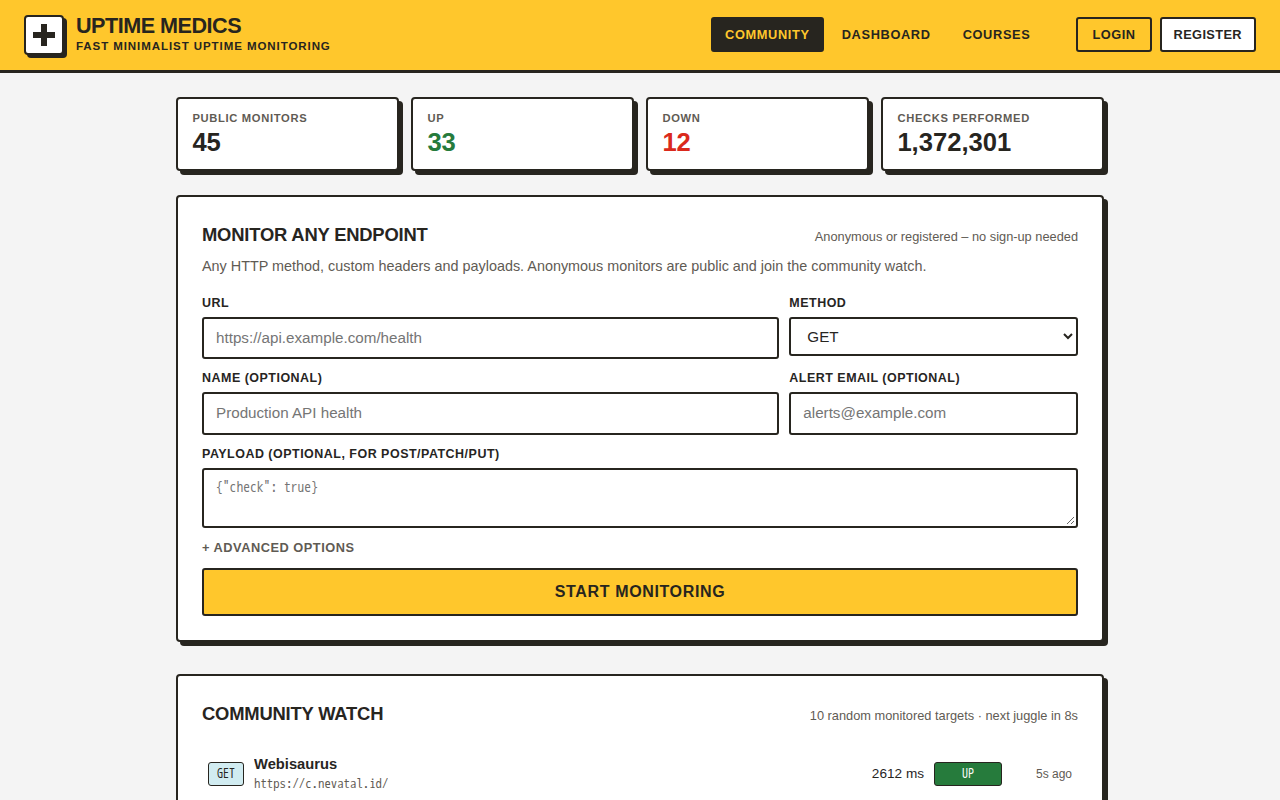
The Problem with Popular Commercial Tools: Expensive Subscriptions & Paywalls
The uptime monitoring market is dominated by SaaS platforms that monetize operational necessity. While they offer polished UIs and deep integrations, the cost structure creates friction for lean teams:
| Tool | Starting Price | Free Tier Limitations | Data Privacy Model |
|---|---|---|---|
| Better Stack | $29–$200/mo | Limited monitors, synthetic checks restricted, log retention caps | SaaS (Vendor hosted) |
| PagerDuty | $21–$41/user/mo | No true free tier for core incident management; trial only | SaaS (Vendor hosted) |
| Pingdom | $15–$150/mo | Single monitor on free tier; 1-min check interval; no SMS/phone alerts | SaaS (Vendor hosted) |
Beyond raw cost, these platforms introduce vendor lock-in. Your historical uptime data, incident timelines, and alerting logic live on their servers. Migrating away often means losing years of SLA evidence. Furthermore, self-hosted alternatives like Uptime Kuma (Node.js/Electron) frequently consume 300–800 MB of RAM, making them impractical for micro-VMs or edge devices.
Introducing Uptime Medics: A Production-Grade Free Alternative
Uptime Medics was built to democratize access to reliable uptime monitoring. It is a single-binary Rust application (axum 0.8 + tokio 1 + reqwest 0.12 + sqlx 0.8/SQLite WAL + lettre 0.11) that delivers enterprise-grade capabilities at $0/month.
It solves the four core problems plaguing the market:
- Cost: Zero licensing fees. Run it on a $3/mo VPS or a Raspberry Pi.
- Resource Efficiency: Baseline memory consumption under 30 MB RAM.
- SSRF Security: Defense-in-depth protection for multi-tenant/public deployments.
- Alert Fatigue: 2-failure state machine with flapping suppression built-in.
Head-to-Head Comparison: Uptime Medics vs. Popular Commercial Paid Tools
| Capability | Uptime Medics (Free) | Better Stack ($29–$200/mo) | PagerDuty ($21–$41/user/mo) | Pingdom ($15–$150/mo) |
|---|---|---|---|---|
| Monthly Cost | $0 | $29+ | $21+/user |
Leave a Reply