Architecting Quanta LMS: High-Performance Benchmarks for a Computational Finance Learning Management System
In the rapidly evolving landscape of quantitative finance, the gap between theoretical mathematical proofs and real-world algorithmic execution is often a chasm of latency and technical friction. Traditional Learning Management Systems (LMS) fail to provide the computational rigor required for MFE (Master of Financial Engineering) and CFA-level training. Enter Quanta LMS—a sophisticated, open-source ecosystem engineered to bridge this gap through high-performance system design and synchronized computational environments.
- Low-Latency Execution: Financial analysis and Python kernels achieve sub-1.5s execution speeds.
- Synchronized Dual-Pane Interface: Real-time KaTeX math rendering paired with a Monaco-driven Python lab.
- High-Fidelity Matching Engine: A continuous double-auction engine supporting complex order types and margin leverage.
- Modern Stack: Built on React 18, FastAPI, PostgreSQL 16, and Python 3.11.
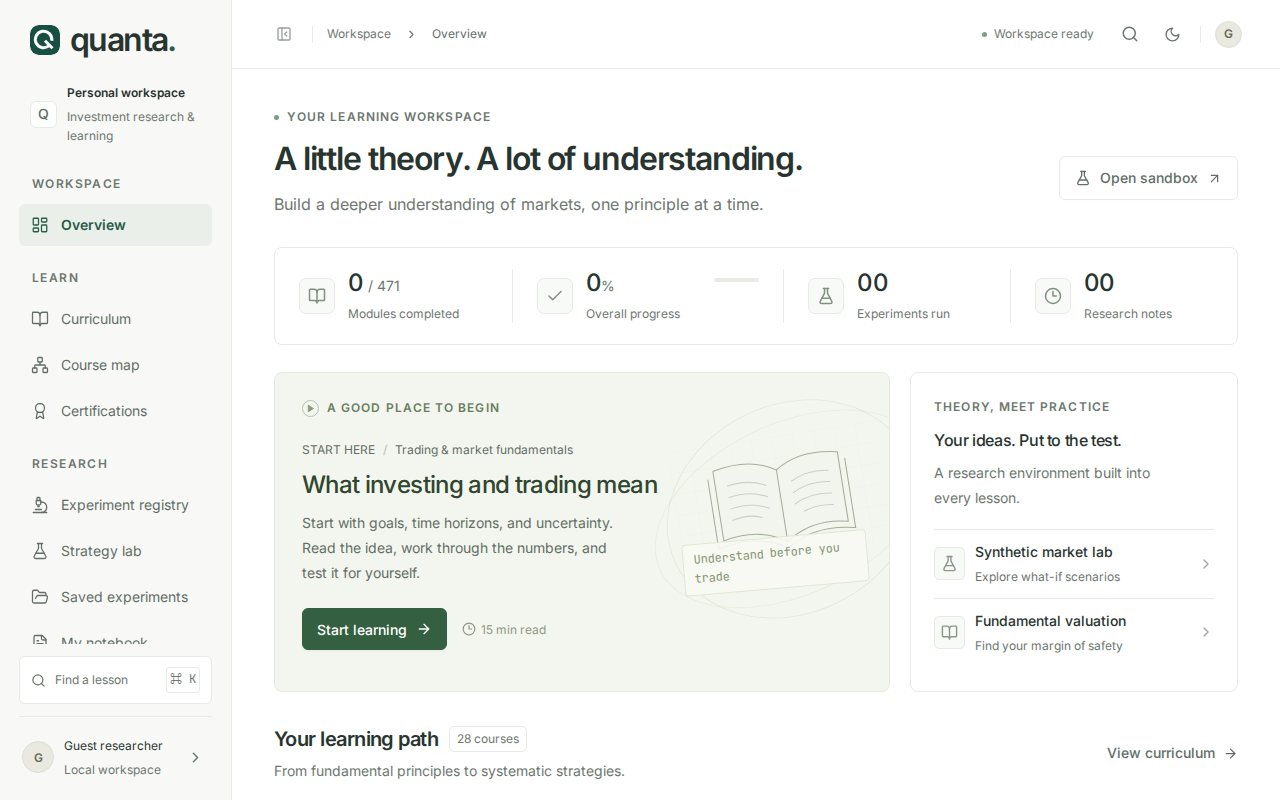
The Engineering Challenge: Why Quanta LMS Was Architected
Most educational platforms treat finance as a static subject—textbooks and multiple-choice questions. However, true quantitative mastery requires interaction. The engineering challenge for Quanta LMS was to build a platform that simultaneously handles:
- Mathematical Rigor: Rendering complex stochastic calculus and econometrics via KaTeX without UI lag.
- Computational Fluidity: Providing an in-browser Python environment that feels as responsive as a local IDE.
- Market Microstructure Simulation: Running a high-concurrency exchange matching engine that accurately simulates order book dynamics, margin calls, and liquidity constraints.
The result is a system designed with a “Substance Over Decoration” philosophy, prioritizing low-latency data flows and architectural integrity over superficial UI flourishes.
Core Architecture & Technical Stack Deep-Dive
Frontend: The Synchronized Intelligence Layer
The frontend utilizes React 18+ to manage a complex, stateful dual-pane interface. On one side, the KaTeX Math Engine provides high-speed rendering of university-grade financial proofs. On the other, the Monaco Editor (the engine behind VS Code) provides a professional-grade Python development environment. This synchronization ensures that as a student reads a proof for a Black-Scholes model, they can immediately implement and test it in the adjacent lab.
Backend: High-Concurrency & Real-Time Data
The backend is powered by FastAPI and WebSockets, enabling the real-time streaming of market data and order book updates. The core of the simulation is a Continuous Double-Auction (CDA) matching engine. Unlike simple simulators, Quanta supports:
- Advanced Order Types: Market, Limit, Stop, Stop-Limit, Trailing Stop, and OCO (One-Cancels-the-Other) Bracket orders.
- Margin & Leverage: Integration of Regulation T margin logic, including short selling with stock borrow locates and automated daily borrow fee accrual.
- Liquidation Logic: Real-time monitoring of equity-to-margin ratios to trigger forced liquidations.
Data & Persistence Layer
PostgreSQL 16 serves as the authoritative source of truth for user portfolios, historical trade data, and curriculum progress. The system is optimized for the high-write throughput required by a continuous matching engine, ensuring that every tick and every trade is recorded with ACID compliance.
Key Features Breakdown & Practical Benefits
1. Multi-Agent LLM Fundamental Analysis
Quanta integrates cutting-edge AI modules that deploy multi-agent LLM architectures to perform autonomous equity analysis. These agents deconstruct balance sheets, normalize earnings, and evaluate debt coverage covenants, mimicking the workflow of a professional fundamental analyst.
2. Six Comprehensive Curriculum Tracks
The architecture supports diverse learning paths, including:
- Graham & Dodd Valuation: Deep dives into intrinsic value and margin of safety.
- Factor Investing & Econometrics: Statistical inference, ARIMA/GARCH modeling, and Fama-French multi-factor models.
- DeFi & Cryptoeconomics: Simulating Constant Product and Concentrated Liquidity AMMs.
Data Flow & How It Works: Step-by-Step Workflow
To understand the performance, one must look at the lifecycle of a single trade execution within Quanta:
- Order Entry: A user submits a Limit Order via the React frontend.
- WebSocket Transmission: The order is pushed via a low-latency WebSocket to the FastAPI backend.
- Matching Engine Processing: The engine checks the order against the current Limit Order Book (LOB). If a match is found, the trade is executed.
- State Update: PostgreSQL updates the user’s margin and position, while the TradingView Lightweight Charts receive a real-time update via WebSockets.
- Feedback Loop: The UI reflects the new price action and updated margin status in <1.5s.
Architectural Comparison: Quanta LMS vs. Traditional Approaches
| Feature | Standard LMS | Quanta LMS |
|---|---|---|
| Execution Environment | Static Text/Video | Live Python 3.11 Kernel |
| Market Simulation | None / Basic Quiz | Continuous Double-Auction Engine |
| Mathematical Rendering | Images/Low-res LaTeX | High-speed KaTeX Engine |
| Trading Complexity | N/A | Margin, Shorting, & Bracket Orders |
Frequently Asked Questions (FAQ)
Is Quanta LMS suitable for professional quantitative research?
While primarily an educational platform, its sandboxed Python environment and high-fidelity simulator allow researchers to backtest factor strategies and algorithmic models in a controlled, realistic setting.
Does the simulator support cryptocurrency trading?
Yes. The curriculum and simulation engine include modules on DeFi Automated Market Makers (AMMs) and cryptoeconomics, allowing for the study of decentralized liquidity dynamics.
How does Quanta handle margin and liquidations?
The system implements institutional-grade margin logic, including Regulation T requirements. It monitors account equity in real-time and executes forced liquidations if margin requirements are breached.
What makes the Python lab different from a standard notebook?
The Monaco-driven lab is tightly integrated with the dual-pane lecture hall, allowing for seamless transitions between mathematical theory and programmatic implementation with sub-1.5s execution latency.
Conclusion & Next Steps
Quanta LMS represents a paradigm shift in financial education. By combining the rigor of a Master of Financial Engineering program with the technical performance of a modern trading platform, it provides the ultimate environment for mastering computational finance.
Whether you are an MFE candidate, a CFA aspirant, or a quant developer, Quanta offers the tools to move from theory to execution with confidence.
Experience the future of quantitative learning today: https://quant.nevatal.id
Leave a Reply