Uptime Medics – High-Performance Uptime & Incident Monitoring: The Best Free Alternative to [Popular Tool]
The Problem with Popular Commercial Tools: Expensive Subscriptions & Paywalls
Developers and teams face relentless financial pressure from commercial uptime monitoring platforms. Better Stack charges $29–$200/mo with strict monitor limits and aggressive upsells. PagerDuty demands $21–$41/user/mo for basic alerting, while Pingdom’s plans start at $15/mo but scale rapidly with features. These services impose tiered paywalls, require credit card details for trials, and lock users into proprietary ecosystems. The result? Teams either overpay for unused capacity or abandon monitoring entirely due to friction and cost.
Introducing Uptime Medics – High-Performance Uptime & Incident Monitoring: A Production-Grade Free Alternative
Uptime Medics was engineered to eliminate the financial and technical barriers of commercial tools. Built in Rust with axum 0.8, tokio 1, and SQLite WAL mode, it delivers sub-30 MB RAM consumption while providing enterprise-grade reliability. Unlike Node.js-based monitors that bloat memory usage, Uptime Medics runs as a single binary with zero external dependencies. Its zero-signup public community pool lets anyone instantly monitor endpoints without registration, while hardened SSRF defenses protect against malicious network probing. This is uptime monitoring democratized: powerful, lean, and 100% free.
Head-to-Head Comparison: Uptime Medics – High-Performance Uptime & Incident Monitoring vs. Popular Commercial Paid Tools
| Feature | Uptime Medics – High-Performance Uptime & Incident Monitoring | Better Stack | PagerDuty | Pingdom |
|---|---|---|---|---|
| Pricing | $0 / 100% Free | $29–$200/mo | $21–$41/user/mo | $15–$150/mo |
| Key Capabilities | Multi-method HTTP probing, SSRF defense, 2-failure state machine, community pools | Advanced APM, logs, traces (premium only) | Alerting, incident management (no monitoring UI) | Uptime checks, synthetic monitoring |
| Paywalls/Limits | None – Zero signup, no limits | Tiered plans with monitor caps | Per-user pricing, feature gates | Feature locks on lower tiers |
| Data Privacy | Full ownership – self-hosted or public pools | Cloud-hosted data, third-party access | Propprietary data pipelines | Cloud-based, no on-prem option |
Core Features You Get Completely Free
Single-Binary Rust Platform with Minimal Footprint
Uptime Medics compiles to a standalone binary consuming under 30 MB RAM, combining axum 0.8, tokio 1, reqwest 0.12, and SQLite WAL mode. This eliminates the 300–800 MB memory bloat of typical open-source monitors like Uptime Kuma, making it ideal for low-cost VPS environments.
Zero-Signup Public Community Monitoring Pool
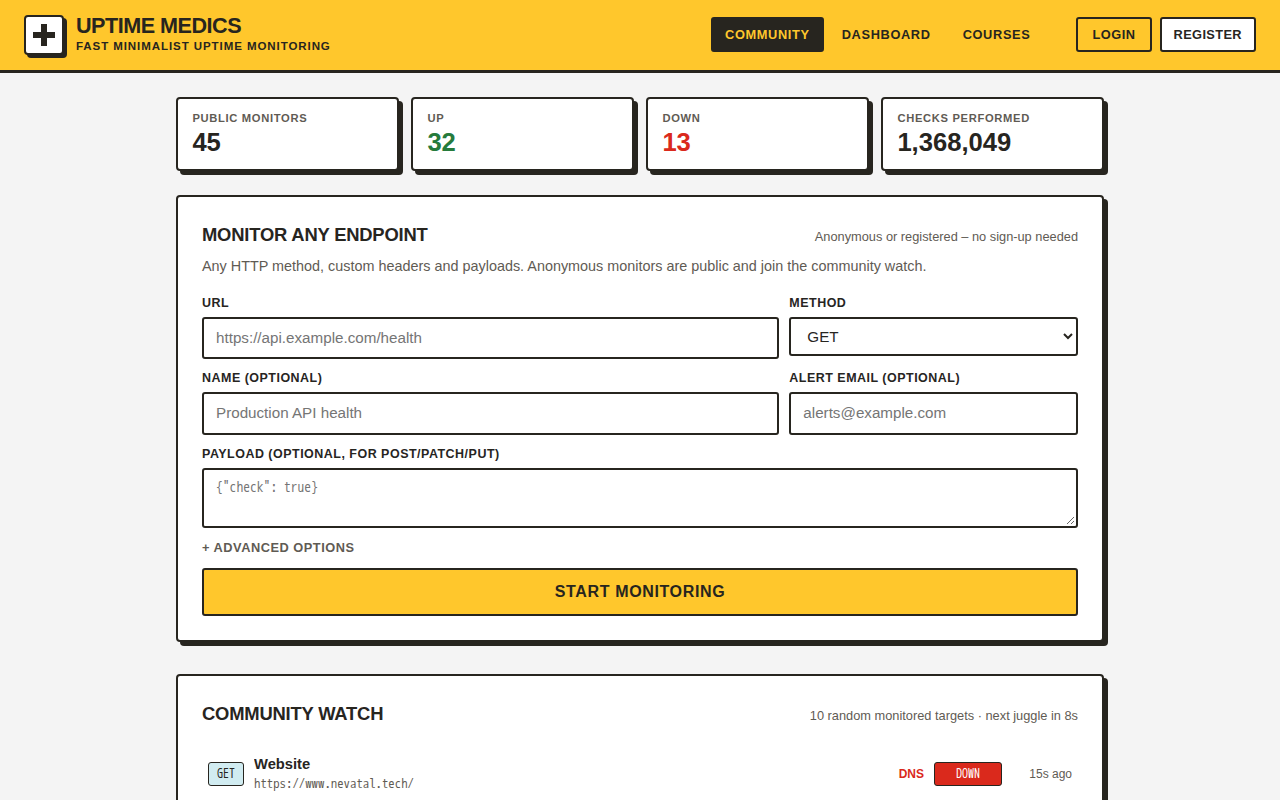
Anyone can instantly submit a public monitor without creating an account. The platform dynamically rotates 10 random community monitors every 10 seconds alongside live global health telemetry, enabling transparent, frictionless monitoring for API operators and indie developers.
Multi-Layer SSRF Defense System
Protected against Server-Side Request Forgery (SSRF) through DNS resolver filtering, DNS rebinding mitigation, and redirect hop inspection. This defense-in-depth approach blocks malicious probing of internal services like cloud metadata endpoints (169.254.169.254) and loopback addresses, critical for self-hosted deployments.
2-Failure Incident State Machine with Flapping Suppression
The system uses a state machine requiring two consecutive failures to trigger an incident, with intelligent flapping suppression and batched SQLite write buffering. This prevents alert fatigue during transient network blips or rapid service oscillations.
Real-World Use Cases: How Users Save Money with This Free Alternative
DevOps Engineers: Eliminate $50+/month costs while maintaining sub-100ms check precision. Monitor critical APIs without credit card requirements or tiered limits.
Indie Hackers: Launch global uptime tracking for public APIs without building custom solutions or paying for third-party SaaS.
Self-Hosted Operators: Deploy hardened monitoring on $5/mo VPS instances with full SSRF protection and zero dependency on external services.
Step-by-Step Guide: How to Get Started with This Free Alternative
- Visit the live platform at https://uptime.nevatal.id.
- Submit a public monitor instantly without signup – no email or password needed.
- Configure probes with custom methods (GET, POST, etc.), headers, and payloads up to 64 KB.
- Access your private dashboard via JWT authentication for multi-endpoint monitoring.
- Review real-time health metrics and incident history in the embedded dashboard.
Frequently Asked Questions (FAQ)
Conclusion & Next Steps
Stop overpaying for uptime monitoring that locks you into costly subscriptions and paywalls. Uptime Medics delivers production-grade reliability with zero financial friction – no credit card required, no vendor lock-in, and full ownership of your monitoring data. For developers seeking a lightweight, secure, and truly free alternative to Better Stack, PagerDuty, or Pingdom, the future of uptime monitoring is here.
\
Leave a Reply