Furina ML Architecture & Performance Benchmark: Leak-Free No-Code ML Workbench Deep Dive
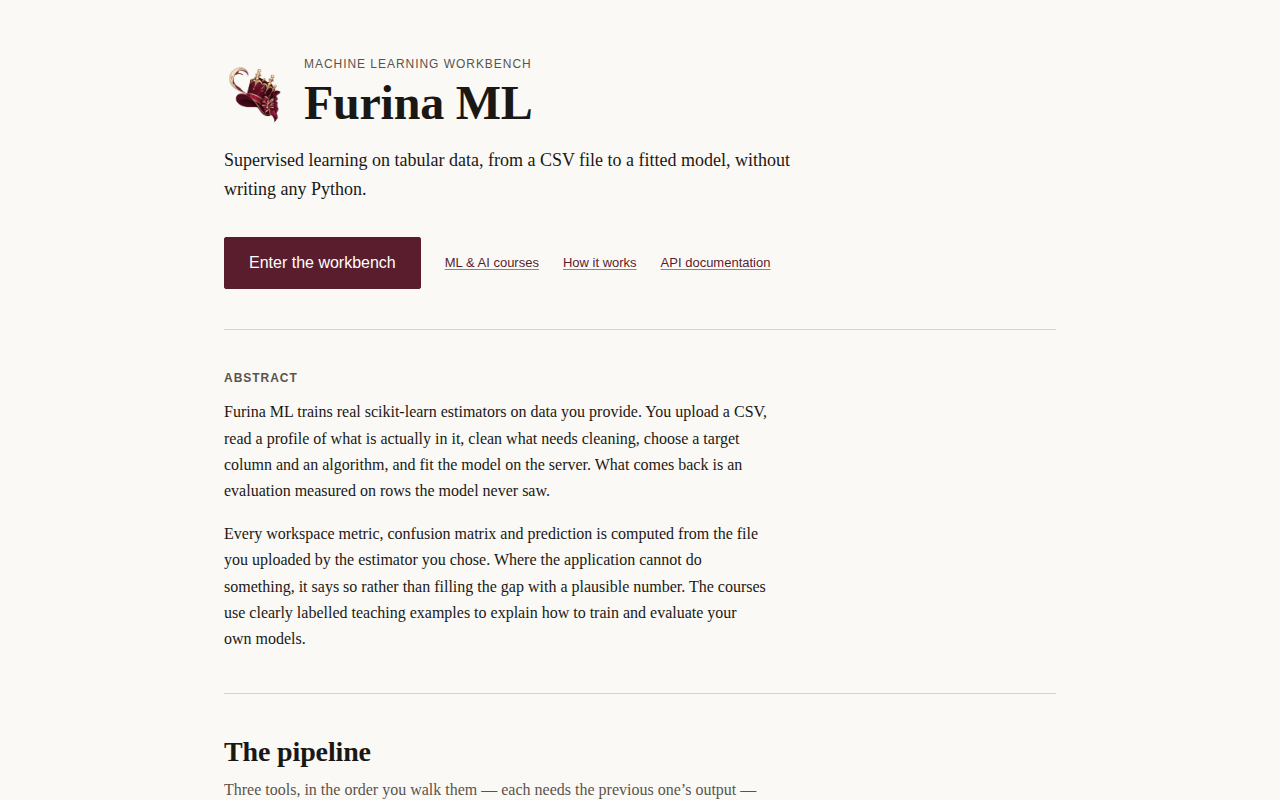
- Zero-Simulation Execution: Trains 19 real estimators (Scikit-Learn, XGBoost, LightGBM) on uploaded CSVs up to 50MB—no mocked metrics.
- Leak-Free by Design: Preprocessing (imputation, scaling, encoding) is bundled inside Scikit-Learn
Pipelineobjects fitted strictly on training splits. - Full Artifact Ownership: One-click export of standalone
.joblibbinaries runnable in any Python environment without platform dependencies. - Privacy-First AI: OpenRouter assistant receives only column metadata and summary statistics—never raw data rows.
The Engineering Challenge: Why Furina ML Was Architected
Tabular machine learning remains the backbone of enterprise analytics, yet the path from raw CSV to production model is littered with boilerplate: Pandas cleaning scripts, Scikit-Learn pipeline assembly, hyperparameter dictionaries, cross-validation loops, and evaluation plotting. Domain experts—clinicians, financial analysts, researchers—face prohibitive programming barriers, while engineers waste cycles rebuilding ad-hoc scaffolding.
Existing no-code platforms often exacerbate two critical failures: data leakage (fitting scalers or imputers before train/test splits) and vendor lock-in (hiding model artifacts behind proprietary APIs). Furina ML was architected to eliminate both. It delivers a browser-based workbench that executes real Python ML training jobs, enforces mathematically correct leak-free pipelines via Scikit-Learn’s native Pipeline API, and emits portable .joblib artifacts that run anywhere Python runs.
Core Architecture & Technical Stack Deep-Dive
System Topology: Multi-Container Docker Compose Stack
Furina ML deploys as a unified stack orchestrated via Docker Compose, isolating concerns into specialized containers:
                  ┌───────────────────────┐
                  │    User Web Browser   │
                  └───────────┬───────────┘
                              │
                              ▼ Port 8080 (HTTP)
                  ┌───────────────────────┐
                  │      Nginx Proxy      │
                  └─────┬───────────┬─────┘
              /api/     │           │ Static SPA Assets
                        ▼           ▼
        ┌───────────────────┐    ┌───────────────────┐
        │   Django 5 API    │    │  Built React/Vite │
        │    (Gunicorn)     │    │  Frontend Bundle  │
        └─────────┬─────────┘    └───────────────────┘
                  │
     ┌────────────┼────────────┐
     ▼            ▼            ▼
┌──────────┐ ┌──────────┐ ┌───────────────────┐
│PostgreSQL│ │  Media   │ │  OpenRouter API   │
│17 (5432) │ │  Volume  │ │ (Metadata Helper) │
└──────────┘ └──────────┘ └───────────────────┘
Frontend: React 18 + Vite + Tailwind CSS
- Interactive SPA: Dataset exploration, cleaning recipe builder, model configuration, and evaluation dashboards.
- Visualization: Chart.js and Recharts power confusion matrices, ROC curves, regression error plots, and feature importance bars.
- Dry-Run Previews: Cleaning recipe steps show instant row/column impact estimates before commitment.
Backend: Django 5 + Gunicorn (Python 3.12)
- REST API: Manages dataset metadata, column profiles, cleaning recipes, training runs, and evaluation metrics.
- Training Execution: Spawns synchronous Scikit-Learn/XGBoost/LightGBM fitting jobs; computes exhaustive evaluation suites (train vs. test overfitting audits, multi-class confusion matrices, ROC-AUC, regression error curves).
- Artifact Serialization: Uses
joblib.dumpto serialize fullPipelineobjects (preprocessing + estimator) to the media volume.
Data Layer: PostgreSQL 17 + Persistent Volumes
- PostgreSQL 17: Persists dataset records, column profile schemas (dtypes, cardinality, missingness, histograms), cleaning recipe JSON, training run configs, and evaluation metric snapshots.
- Media Volume (
media_data): Stores raw uploaded CSVs, versioned derived datasets from cleaning recipes, and exported.joblibmodel binaries. - DB Volume (
db_data): Ensures PostgreSQL state survives container restarts.
AI Layer: OpenRouter Integration (Privacy-Preserving)
The in-app assistant sends only column metadata (names, dtypes, cardinality, missing %, summary stats) to OpenRouter—never raw rows. It advises on cleaning strategies (imputation choices, encoding approaches) and model tuning (hyperparameter ranges, algorithm selection) based on dataset profile alone.
Key Features Breakdown & Practical Benefits
1. Zero-Simulation Model Training (19 Algorithms)
| Category | Algorithms |
|---|---|
| Scikit-Learn (17) | Logistic/Linear Regression, Ridge, Lasso, ElasticNet, KNN, Decision Tree, Random Forest, Extra Trees, Gradient Boosting, HistGradientBoosting, SVM (LinearSVC/SVC/SVR), Naive Bayes (Gaussian/Bernoulli/Multinomial), MLP |
| XGBoost | XGBClassifier, XGBRegressor |
| LightGBM | LGBMClassifier, LGBMRegressor |
Every metric—accuracy, F1, ROC-AUC, RMSE, MAE, R²—is computed by fitting the actual estimator on the user’s data. No surrogate models, no approximations.
2. Leak-Free Scikit-Learn Pipelines
Pipeline(steps=[
  ('imputer', SimpleImputer(strategy='median')),
  ('scaler', StandardScaler()),
  ('encoder', OneHotEncoder(handle_unknown='ignore')),
  ('estimator', RandomForestClassifier(...))
])
The entire preprocessing chain is fitted exclusively on the training split. The test split remains unseen until final evaluation—eliminating the silent leakage that plagues manual workflows and lesser platforms.
3. Visual Non-Destructive Cleaning Recipes
- Operations: drop columns, filter rows, impute missing values, type casting, derive new columns via expressions.
- Each recipe produces a versioned derived dataset with full lineage tracking.
- Instant dry-run preview shows affected row counts and column schema changes before apply.
4. Exhaustive Evaluation Suite
- Overfitting Audit: Side-by-side train vs. test metrics for every run.
- Classification: Multi-class confusion matrices (normalized + raw), per-class precision/recall/F1, ROC-AUC (macro/micro), PR curves.
- Regression: Residual plots, predicted vs. actual scatter, error distribution histograms, RMSE/MAE/R² breakdowns.
5. One-Click .joblib Export & In-Browser Prediction
- Download the full fitted
Pipelineas a standalone binary. - Load in any Python
Leave a Reply