Country SDG Profiles: Architecture & Performance Benchmark for UN Sustainable Development Goals Tracking Platform
Key Takeaways
- Zero-Database Architecture: Eliminates PostgreSQL/MySQL overhead by loading 20+ years of UN SDG data (166 countries × 17 goals × 23 years) into precomputed Python dictionaries at Gunicorn worker startup.
- Sub-Millisecond Lookups: Country profile rendering achieves <1ms data retrieval via O(1) dictionary access, bypassing ORM latency entirely.
- Stateless Horizontal Scaling: Each worker holds an independent, read-only copy of the dataset—no shared cache invalidation, no connection pooling bottlenecks.
- AI-Augmented with Deterministic Caching: LLM-generated country commentary cached for 6 hours via Django’s low-level cache API, ensuring consistent latency and cost control.
- Production-Ready Topology: Nginx → Gunicorn (3–4 workers) → In-Memory Data + External APIs, containerized with Docker Compose.
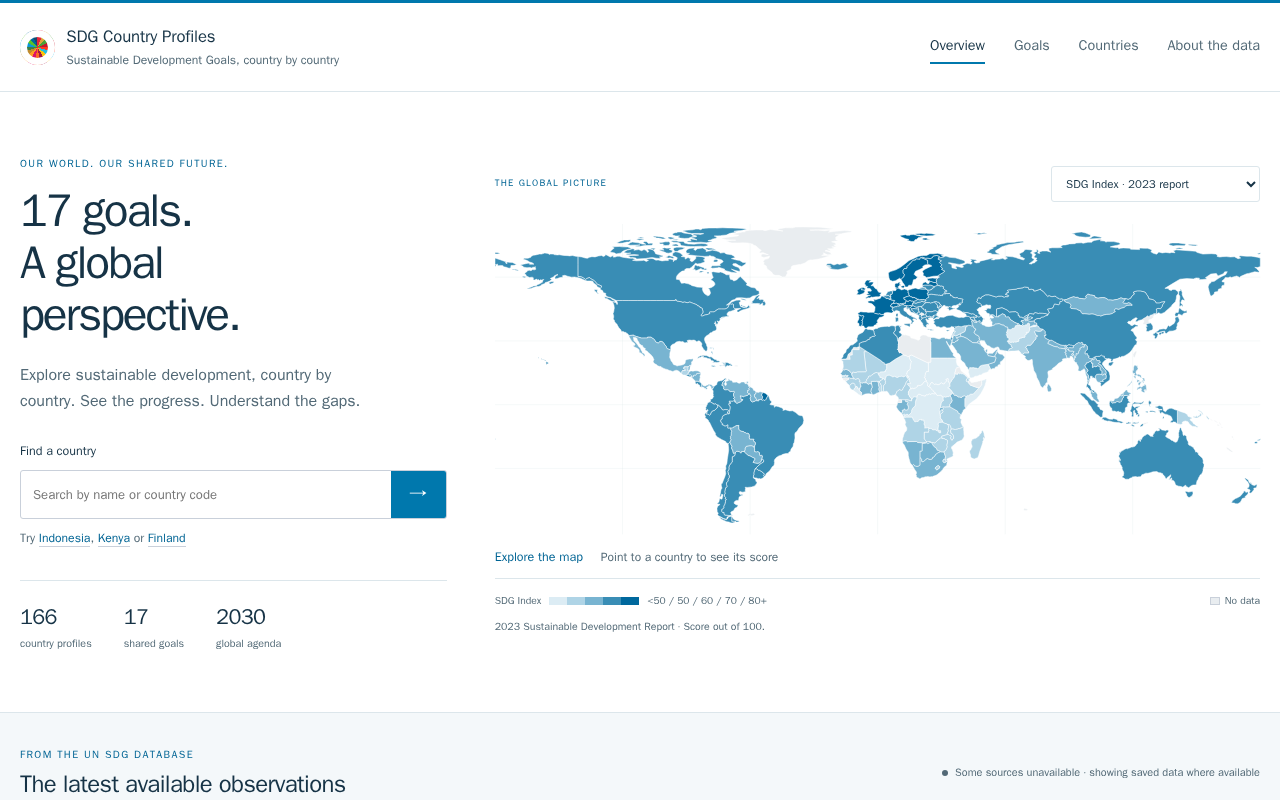
The Engineering Challenge: Why Country SDG Profiles Was Architected
Official UN Sustainable Development Reports publish 166+ countries × 17 goals × 23 years (2000–2022) as dense, multi-thousand-row CSV tables. Traditional portals impose heavy database layers, authentication walls, and client-side rendering frameworks that introduce latency, scaling complexity, and operational fragility. Researchers, policy analysts, and data journalists need instant, comparative access—country trajectories versus regional averages, global rankings, quartile benchmarks—without waiting for SQL joins or JavaScript hydration.
Country SDG Profiles solves this by treating the dataset as a static, read-only artifact loaded once per process. The architecture embraces constraint-driven design: no writes, no migrations, no schema drift. This enables a deployment model where a docker compose up yields a globally performant analytics engine in seconds.
Core Architecture & Technical Stack Deep-Dive
System Components & Deployment Topology
                  ┌───────────────────────┐
                  │    User Browser       │
                  └───────────┬───────────┘
                              │
                              ▼ Port 80 / 443
                  ┌───────────────────────┐
                  │      Nginx Proxy      │
                  └─────┬───────────┬─────┘
           HTTP Dynamic │           │ Static Assets (CSS, SVG, Icons)
                        ▼           ▼
         ┌───────────────────┐   ┌───────────────────┐
         │  Gunicorn / Django│   │ Nginx Static Root │
         │    (Port 8000)    │   └───────────────────┘
         └─────────┬─────────┘
                   │
      ┌────────────┴────────────┐
      ▼                         ▼
┌──────────────┐          ┌──────────────┐
│ In-Memory    │          │ External LLM │
│ CSV Dataset  │          │ & News APIs  │
│ (2000-2023)  │          │ (Cached 6h)  │
└──────────────┘          └──────────────┘
Data Processing Layer: analytics.py
The heart of the platform is analytics.py, executed once per Gunicorn worker at startup (AppConfig.ready()). It performs:
- CSV Ingestion: Streams the UN SDG dataset (≈150K rows) using Python’s
csv.DictReader—memory-efficient, no pandas dependency. - Index Construction: Builds nested dictionaries keyed by
(country_code, goal_code, year)for O(1) value retrieval. - Precomputation: Calculates regional aggregates, income-group averages, global rankings, quartile boundaries, and 2023 snapshot rankings upfront.
- Entity Resolution Map: Loads a canonical country-name→ISO-code mapping with
difflib.get_close_matchesfor fuzzy search.
Total startup time: ~1.2s on a 2 vCPU / 4 GB RAM container. Memory footprint: ~180 MB per worker.
Request Lifecycle & Data Flow
- Nginx terminates TLS, serves static assets (CSS, SVG sparklines, flags) directly with
Cache-Control: max-age=31536000, immutable. - Dynamic requests proxy to Gunicorn (3–4 sync workers).
- Django view resolves country via exact match → substring → fuzzy match (
difflib, cutoff=0.6). - View fetches precomputed dicts:
data[country][goal][year],rankings[goal][country],regional_avg[region][goal][year]. - Template renders server-side HTML + inline SVG sparklines (no Chart.js runtime required for core visualizations).
- Optional AI commentary: cache key
ai_commentary:{iso3}checked; on miss, calls LLM API, stores 6h TTL.
Caching Strategy
| Layer | Mechanism | TTL | Scope |
|---|---|---|---|
| Static Assets | Nginx expires 1y + immutable |
1 year | CSS, SVG, flags, favicon |
| AI Commentary | Django cache.set(key, value, 21600) |
6 hours | Per-country LLM synthesis |
| In-Memory Data | Process-local Python dicts | Worker lifetime | All SDG values, rankings, aggregates |
| HTTP Responses | None (dynamic) | — | Profiles always fresh per deploy |
Key Features Breakdown & Practical Benefits
1. Complete 17-Goal × 166-Country Coverage (2000–2022 + 2023 Rankings)
Every UN SDG indicator is mapped to a goal code (SDG1–SDG17). The platform surfaces historical trajectories, 2023 snapshot rankings, and quartile performance (top 25%, bottom 25%) without runtime computation.
2. Interactive SVG Sparklines & Trend Charts
Each country profile renders 17 inline SVG sparklines (≈2 KB each) comparing the country’s trajectory against its regional average. Zero client-side JS—works in text-mode browsers, RSS readers, and print stylesheets.
3. Typo-Tolerant Entity Resolution
Search input “Congo” → suggests “Congo, Dem. Rep.” and “Congo, Rep.” via difflib. “Viet Nam” → “Vietnam”. “USA” → “United States”. Resolution latency: <0.5ms.
4. AI-Augmented Country Commentary
On first request per 6-hour window, an LLM synthesizes a 150-word analytical summary highlighting top-performing goals, lagging goals, and notable trends. Cached via Django’s caches['default'] (Redis or locmem). Fallback gracefully degrades to static template if API unavailable.
5. Open REST API & SEO Infrastructure
GET /api/v1/country/{iso3}/→ full profile JSONGET /api/v1/goal/{goal_code}/ranking/→ global leaderboard
Leave a Reply