Webisaurus Architecture & Performance Benchmark: Zero-Backend Polyglot Syntax Reference for 140 Languages
- Zero-Backend Static Architecture: Pure HTML5, Vanilla CSS, ES6+ Modules served via Nginx Alpine (< 25 MB RAM) — no Node.js runtime, no build step, no database.
- Massive Data Scale, Minimal Footprint: Indexes 140 programming languages across 24 syntax concepts (3,360 idiomatic snippets) with instant client-side rendering.
- Two-Tier Caching & PWA Offline-First: In-memory Map + localStorage persistence with quota management; Service Worker (Cache API) enables full offline capability.
- Keyboard-First Command Palette: Unified fuzzy search (Ctrl+K / Cmd+K / /) across languages, concepts, and actions in milliseconds.
- Production URL: https://c.nevatal.id
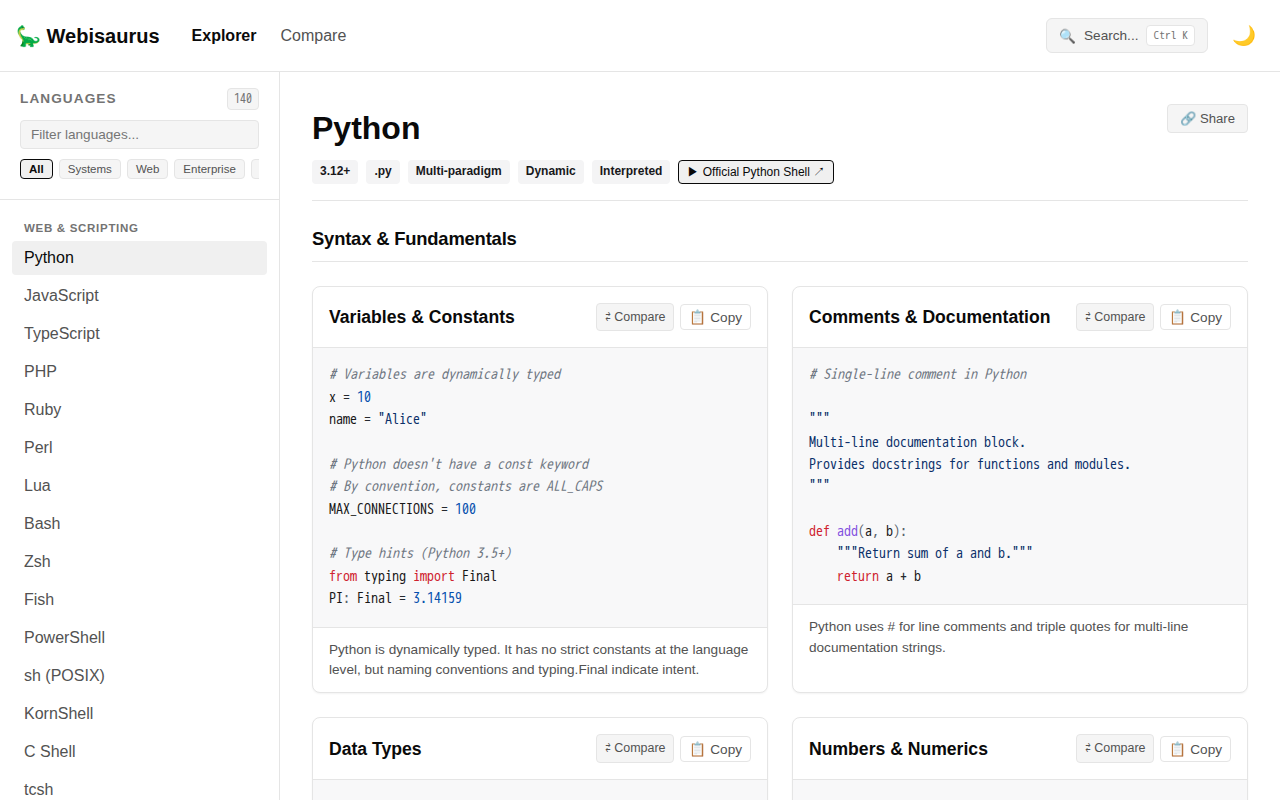
The Engineering Challenge: Why Webisaurus Was Architected
Modern polyglot engineering imposes a steep context-switching tax. Developers migrating services from Python to Go, writing systems extensions in Rust or Zig, or modeling data in Julia and SQL traditionally juggle fragmented documentation silos, heavy framework-laden doc sites, and unreliable offline access. Existing solutions suffer from:
- Siloed Documentation: No synchronized side-by-side comparison of idiomatic constructs across languages.
- Framework Bloat: Heavy client bundles, hydration cycles, and server dependencies that fail in air-gapped environments.
- Latency & Fragility: Round-trips to backend APIs for syntax lookup introduce unacceptable latency for reference workflows.
Webisaurus solves this by inverting the model: ship the entire knowledge base as static assets, execute all logic client-side via vanilla ES6 modules, and leverage browser caching primitives for instant, offline-capable access.
Core Architecture & Technical Stack Deep-Dive
1. System Topology: Pure Static Delivery
The deployment model is a single hardened nginx:alpine container exposing port 80/8080. There is no application server, no database, no build pipeline, and no server-side rendering. The container serves three asset classes:
- HTML Documents:
index.html(Explorer),compare.html(Comparator),manifest.json(PWA). - CSS & Scripts:
main.css(Design System),app.js(ES6 Module entry),sw.js(Service Worker),prism.min.js(Syntax Highlighting). - Static Data:
registry.json(Language metadata),concepts.json(24 concept definitions),snippets/*.json(3,360 code snippets, one file per language).
Resource Profile: The Nginx Alpine container runs at < 25 MB RSS under load, making it suitable for edge nodes, Raspberry Pi clusters, or air-gapped appliances.
2. Data Architecture: Registry-Driven Lazy Loading
Webisaurus avoids monolithic JSON bundles. Instead, it employs a Registry + Sharded Snippet pattern:
// registry.json (loaded on boot, ~40 KB)
{
  "languages": [
    { "id": "rust", "name": "Rust", "paradigms": ["systems", "functional"], "snippetFile": "snippets/rust.json" },
    ... 139 more
  ]
}

// snippets/rust.json (lazy-loaded on demand, ~2-5 KB)
{
  "variableDeclaration": "let x: i32 = 42;",
  "functionDefinition": "fn add(a: i32, b: i32) -> i32 { a + b }",
  ... 22 more concepts
}
This yields instant cold-start (registry only) and progressive data fetch only when a language is selected in the Explorer or Comparator.
3. Two-Tier Caching Engine
The caching layer is implemented in cache.js (ES6 Module) with a strict hierarchy:
| Tier | Storage | Capacity | Eviction Policy | Use Case |
|---|---|---|---|---|
| L1 (Hot) | In-Memory Map |
Unbounded (JS Heap) | LRU (max 200 entries) | Active session: registry, active language snippets, search index |
| L2 (Warm) | localStorage (JSON) |
~5 MB quota | Timestamp-based TTL (7 days) + Quota Manager | Persisted snippets, user preferences, last-viewed state |
The Quota Manager monitors localStorage usage; on QuotaExceededError, it evicts least-recently-used snippet files until write succeeds. This guarantees PWA reliability on constrained devices (iOS Safari 50 MB limit, private browsing restrictions).
4. Service Worker: Offline-First PWA
The sw.js implements a Stale-While-Revalidate strategy for static assets (HTML, CSS, JS, Prism) and a Cache-First strategy for data shards (snippets/*.json). On install, it precaches the app shell (index.html, compare.html, manifest.json, main.css, app.js, prism.min.js, registry.json, concepts.json). Subsequent navigations serve instantly from Cache API; snippet fetches populate the runtime cache transparently. The result: full offline functionality after first visit — critical for air-gapped development environments.
5. Client-Side Rendering: Vanilla ES6 Modules
No React, Vue, Svelte, or build tools. The app entry app.js uses dynamic import() for code-splitting:
explorer.js— Single-language syntax explorer (lazy-loaded onindex.html)comparator.js— Multi-language side-by-side comparator (lazy-loaded oncompare.html)palette.js— Command palette fuzzy search (loaded on firstCtrl+K)search-index.js— Pre-built Fuse.js index for 140 languages × 24 concepts (loaded on palette open)
Prism.js handles syntax highlighting via prism.min.js + language components loaded on-demand via Prism.plugins.autoloader.
Key Features Breakdown & Practical Benefits
Side-by-Side Code Comparator (compare.html)
- 2-to-3 Column Reflow: CSS Grid layout (
grid-template-columns: repeat(auto-fit, minmax(320px, 1fr))) stacks responsively to single column on mobile. - Slot Swapping: Drag-and-drop or keyboard swap language positions without re-fetching snippets.
- Shareable URLs:
?l1=rust&l2
Leave a Reply